Manuel had traveled from El Salvador, through Guatemala and Mexico to
the U.S. Border at Nogales because he wanted to get away from the militaristic
repressive reaction to gang violence in his country and planned to help support
his family In 2015, 6,656 people were killed in El Salvador, a murder
rate more than 17 times the global average, according to the government
organization Instituto de Medicina Legal.
Just 21 years old, he’d crossed into the U.S and survived in the lethal heat of
the Sonoran Desert. But shortly after crossing the border, something happened
to end his plans.
“I heard the ‘Migra,’ he told me, the pejorative Spanish word used to
refer to U.S. Customs and Border Protection (CBP) or any of its law enforcement
arms, “so I hid under a fallen tree. After they’d left the area it was daylight,
and I had to stay hidden there until nightfall. And I’d run out of water. It
was a long hot day under that tree. When I finally felt it was safe to move at
nightfall, I was on my way to a home of friends I knew I could trust. But just
as I was approaching their house, the Migra came speeding up in their patrol,
and grabbed me, forcing me to the ground. My friends had to disavow knowing me
because of the legal implications they’d face being suspected of harboring
border crossers. I was coughing and vomiting, suffering so much from
dehydration and fatigue that, once I was in their Chevy Tahoe, they had to take
me to emergency. Once I recovered a couple days later, they asked me questions and
filled out papers and then took me to drop me off back in Mexico.” As a
“first-time border-crosser” Manuel was held 72 hours to complete processing before
being transferred over to ICE Enforcement and Removal Operations.
 |
After his helping clean up following the breakfast and before he was
leaving, Manuel and I exchanged
blessings and he gave me the cross he
wore around his neck during his crossing,
a gift I treasure |
My
encounter with Manuel happened at “El Comedor” in Nogales, Mexico, just over the border. El Comedor is a
cooperative service for stranded immigrants run under the Jesuit Refugee Services
program, Kino Border Initiative. The morning I met him there, invited to come see the center by MaryJoan
PIcone, he was among 65 men, women and children who were being served breakfast.
MaryJoan, a parishioner of St.Patrick-St. Anthony in Hartford, has been volunteering annually at this center for a number of years,
having heard of it through her work among the farm workers who travel across
the border to work in Connecticut orchards through the growing season each year.
In addition to a nutritious meal every day, the service center offers border-crossers the kindly and encouraging care of other services—including
everything from medical attention to civil rights education—aimed at recognizing
dignity and political empowerment against possible abuse by law enforcement. Manuel, like the others at breakfast that day—some
of whom had come from as far away as Colombia—had spent all his money for
travel to the border. Most pay for the services of a “coyote” who gets them across
the border, but from there they were on their own. But then, when they get
picked up by Border Patrol, agents drop them back across the border in Mexico.
When I asked if he’d try to cross again, his forlorn expression accompanied his
response: “I don’t think so.” Manuel has probably heard from others that if he
gets picked up crossing again, the offense is no longer a misdemeanor, but a felony,
which entails a fine and imprisonment. But now he still faces the uncertainty
of how he’ll be able to get the money to make the more than 600 mile return
trip home.
 |
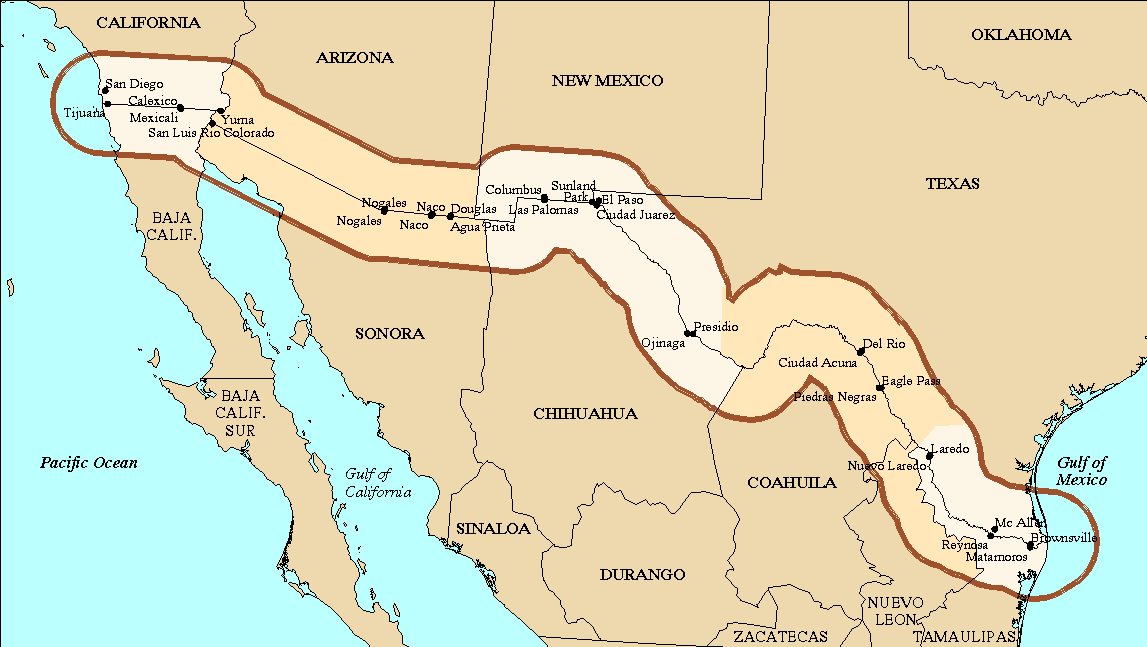
A map of the Nogales border area gives a sense of the extent of the activities of the weekend of
the SOAW Convergence. Phoenix is at the top left of the map. Driving distance from Nogales
to Eloy in the upper left section of the map is 114 miles. |
Why Did SOAW go to the Border
this year?
The story of Manuel and the constant flow of hundreds of other "border-crossers" caught
and "dumped" back across the border by U.S. Border Patrol and
being served everyday at El Comedor and other such charitable service centers
along the border is at the heart of why there was a 2016 School of the Americas
Watch Bi-National Encuentro, October 7-10 in Nogales—on both the U.S. and
Mexico side of the border wall. During three days before meeting Manuel, I was one
of a five member-delegation of Progressive Catholic Coalition taking part with over
a thousand activists from the US and Mexico in
the event organized by SOAW. The plight of Manuel, and thousands of others suffering worse conditions as border-crossers forced to leave their countries by horrific conditons, is the reason
SOAW had chosen to hold this event to increase awareness of the militarization
of the U.S.-Mexico border and Latin America, as well as the criminalization of
immigrants, asylum seekers, refugees and people of color. This is the first
time SOA Watch is turning all eyes onto the borderlands and the way this
country has responded to the mass migration coming from our neighbors to the
south.
Most
importantly, this year’s annual gathering aimed at reinforcing solidarity during
times when xenophobia, racism and imprisoning humans for profit seem to be at
all-time high. Workshops on Saturday included talks on how the US has spread
mass incarceration in Mexico; the human rights crisis faced on the border; the
deportation of veterans; and indigenous resistance: from the Tohono O’odham
Nation to the Lenca peoples of Honduras fighting against military repression,
as they struggle with the detrimental effects capitalism has had on their
environment and livelihoods.
Why the vigil at Eloy Detention
Center?
For several years SOAW has
held a rally at Stewart Detention Center in Lumpkin, Georgia, in conjunction with
the convergence at the gates of Ft. Benning. Those rallies served as a prelude
to the weekend at the border which began
with a gathering of hundreds on Friday evening at the Eloy Detention Center, where a capacity
for 1500 men, women and children are housed here, an almost two hour drive from
Nogales. This Eloy detention center and the one in Lumpkin are just two of a number of such for-profit
facilities around the country run by CCA [Corrections Corporation of America].
Operating since 1983, CCA is the
fifth-largest corrections system in the nation, behind only the federal
government and three states. CCA houses nearly 70,000 inmates in more than 70
facilities, the majority of which are company-owned, with a total bed capacity
of more than 80,000. The vigil at Eloy
drew “more people than had ever gathered before” according to one comment and
aimed at drawing attention to the abuses in such facilities that depend on
keeping detention levels at capacity to justify their existence and to maintain
profitability. An interesting side note: on the day following the November
election, the stock in Corecivic Inc., which operates CCA, rose sharply by 6
points and has remained at about that level since then.
 |
As
names of missing border-crossers are intoned, a participant
respectfully tips
his hat as he joins vigilers in responding “Presente”
—indicating that they are
not forgotten by those who continue to
work for justice.
|
Highlighting the militarization present on the south border
of our country, the figures tell the story of statistics, not the human cost.
The U.S. Border Patrol keeps track of only those apprehended at the border, not
of those who die or “disappear” crossing the border. The U.S. CBP reports that “in
Fiscal Year 2016, total apprehensions by the Border Patrol on our southwest
border, between ports of entry, numbered 408,870. This represents an
increase over FY15.”
 |
Relatives
of detainees hold a poster
proclaiming their sentiments
about
Immigration and Customs Enforcement tactics.
|
Through
the first six months of fiscal 2016, which ended on March 31, border
officials apprehended 27,754 unaccompanied children, the CBP reported—a 78
percent jump from the 15,616 apprehended in 2015, and just shy of the 28,579
apprehended in 2014.
A year ago the LA Times reported that “even more people died attempting the
perilous crossing: 117 bodies have been recovered along migration routes in
southern Arizona since Jan. 1, (2015) compared with 108 bodies during the same
period last year” and that “most of the migrants who crossed the U.S. border
last year were from violence-ridden countries in Central America.” The majority
comes from El Salvador, Honduras and Guatemala, where violence and repressive
regimes hold sway, and the only Central American countries, incidentally, which
send officers for training at the U.S. Army School at Ft. Benning.
Meeting Manuel,
as well as hearing so many of the relatives describing situations faced by detainees at the Eloy Rally, made the justice issues around these facts and figures very humanly alive.
More pictures of the other activities of the weekend are at
 |
| Eloy Deetention Center off in the distance, the closest anyone in the vigil was allowed to approach, appears deceptively harmless against the picturesque desert sunset as the rally goes on. | | |
| |
|
 |
| The semi-trailer portable stage serves as the platform of the rally. In the background, beyond the stage, is the detention center. |
 |
| Performers adding spirit to the Vigil include Pablo Peregirna, Olmeca, Charlie King Collen Kattau and Emma's Revolution. |
 |
| Expressing one of the themes of the vigil, the placard held by a member of El Pueblo Unido proclaims it message against the backdrop of the detention center. |
Why this SOAW Convergence in October?
Since 1991, SOAW has held the annual convergence in Columbus, Georgia at
Ft. Benning in November to commemorate the massacre of the six Jesuits and
their coworkers in 1989 by forces under the command of SOA graduates. While a
smaller observance at Ft. Benning was held in November this year, the date
chosen for this year’s large gathering coincides with the 4th
anniversary of the death of 16-year-old Jose Antonio Elena Rodriguez who was killed
on Mexican soil by a U.S. Border Patrol agent shooting through the border wall.
Autopsy reports show that Jose Antonio was hit from behind by ten shots. The
wall of the building on Calle International still shows bullet holes, some
outlined in red marker. During an
incident at the border wall in which he was not involved, he was throwing rocks
at the wall. Shooting by Border Patrol agents through the border wall was such
a common occurrence that the U.S. Customs and Border Protection
commissioned The Police Executive Research Forum to address border protection
use of force review cases and policies in a position paper in 2013. The
recommendations by PERF concluded that
“review of shooting cases involving rock throwers revealed that in some
cases agents put themselves in harm’s way by remaining in close proximity to
the rock throwers when moving out of range was a reasonable option.” It
took until September 2015 for an indictment by a Federal Grand Jury to bring a
charge of second-degree murder against Border Patrol agent Lonnie Ray Swartz. The trial began just this past
November 7th.
 |
Jose
Antonio is memorialized in a portrait on the Mexico side just below the slotted
border wall through which he was shot
and killed October
10, 2012.
|
On Saturday morning, over 1,000 participants marched the two miles from
the hotel headquarters to U.S./Mexico border, ending at
Ambos Nogales, the city on both sides of the border created by the
1853 Gadsden Purchase—Nogales Arizona, U.S.A. and Nogales, Sonora, Mexico. The
program included testimony from those detained and deported, including U.S.
veterans, interspersed with music from nationally-known folk artists who led
songs of protest. Later in the day there were various educational workshops,
including how to build a grassroots organization, how trade agreements cause
economic and labor abuse, and how to refuse to pay taxes so as not to support a
war; concerts at the border; and a prayer vigil for young Jose Antonio.
 |
Father Roy Bourgeois joins in the march preparations as he speaks with Jeff and Margaret Murphy Sweetland.
THE MARCH TO THE BORDER
Carrying the PCC Banner, Jack Wentland walks with the over-a-thousand who walked the 2 miles to the locations on each
side of at the border wall where stages were set up for thepresentations and music.
A couple recruited by Janice Sevre-Duszynska carry the ARCWP Banner
The
March makes its way along the U.S. side of the border wall to one stage while
others are marching on the Mexico side
to another stage.
|
On Saturday afternoon participants joined the Anniversary Vigil for Jose Antonio in
Nogales, Sonora: starting with a march from the Plaza de las Palomas in
Nogales, Sonora to the site where Jose Antonio was killed by Border Patrol and
a mass with the Bishop José Leopoldo González González, whose has served only a year and a half in the
new Mexican diocese.
Following that vigil, an interfaith candlelight
vigil at the border wall—planned by a national committee which included PCC
members Janice Sevre-Duszynska, Silvia Brandon-Perez and Jack Wentland—was held. Various religious groups—including the local indigenous
indigenous Tohono O’odham
Nation, Muslim, Jewish and Christian—offered prayers for people striving to overcome border injustices across the globe.
https://www.facebook.com/pcc4churchjustice/posts/1205059539540175
The full text of the Interfaith Candlelight Service, including the PCC message and prayer led by Janice Sevre-Duszynka
and Jack Wentland is at:
https://www.facebook.com/pcc4churchjustice/posts/1205059539540175
The complete service was translated and interpreted in Spanish by PCC member Silvia
Brandon-Perez.
More pictures of the service are at
https://www.facebook.com/pcc4churchjustice/photos/?tab=album&album_id=1205041056208690
The SOA Watch full coverage of the weekend is at
http://soaw.org/news/organizing-updates/4396-border-convergence
On Sunday more than 200 activists, including Father Roy, continued their
demonstration in a march to the US Border Patrol interior vehicle checkpoint on
the I-19 highway
20 minutes north of Nogales. Taking part in the direct action was Janice
Sevre-Duszynska, ARCWP and representing that
organization in PCC. She reported
that she
"stayed here from 2 p.m.- 8 pm. taking part in
a continued witness as cars slowed down at the Checkpoint. The Border Patrol
attempted to intimidate us with dogs and pepper spray and (according to our
legal team) they also threatened us with various charges from a Federal Felony
to State charges and a misdemeanor traffic violation. They did not arrest us
even during our die-in which was truly a Eucharist."
Challenging the legitimacy of such checkpoints, which are not only notorious
for rampant human rights abuses towards Arizona residents but also directly
responsible for the deaths of more than 3,000 human beings forced to traverse
the desert to avoid them, we lifted up Article 13 of the Universal Declaration of
Human Rights which guarantees all human beings freedom of movement, the right
to leave and the right to return to their countries. Calling out, "we
remember all the people these checkpoints kill, we can feel their spirits, they
are with us still," a large number of the demonstrators staged a
nonviolent die-in.
Video of the direct action at the checkpoint is at
http://www.soaw.org/border/livestream/
The Progressive Catholic Coalition
This Catholic reform presence by
Progressive Catholic Coalition is made possible by the funding provided by
organization representatives of each the organizations: Kay Akers (WOC), Sophie
Vodvarka and Rosa Manriquez (CTA), Janice Sevre-Duszynska and Silvia
Brandon-Perez (ARCWP), and Jack Wentland (CORPUS, FCM and CITI Ministries,
Inc.; funded also by a personal donation by Roll Away The Stone). This
representation as well as the funding provided by the coalition-member
organizations makes possible the PCC's valuable message for justice.
Sophie
Vodvarka of Call to Action has created videos covering highlights of the two
days:
Part
1 - Introduction, Background and Rally at the Eloy Detention Center
Part
2 - Crossing the Border with Background on Why "SOAW to the
Border"
/
The
Bottom Line
Many
may wonder if there’s a point to SOA Watch’s activities over the years. The
point is the consistent effort of SOAW to draw attention to the impact
of U.S. militarism, both that exported to Latin America through training of officers
from those countries and that implemented at our southern border by Border Patrol
policies and abuses . Such exercise of military repression in their countries
has forced people from their homes to save their lives up North only to meet
with military abuses at the border.
In recent years, SOA Watch has been
focusing attention on legislation in congress that would close the SOA/WHINSEC allowing
for review of the records of the graduates. Most recently the efforts of SOAW have
gained the most bi-partisan co-sponsorship for HR 5474, the Berta Caceres Human Rights in Honduras
Act. The bill is named for a
Honduran indigenous activist gunned down in March by forces of the regime set
up in a coup by military who are graduates of the SOA. More about Berta Caceres
Those who are advocates for justice have contacted their congress persons asking them to sign on as co-sponsors of
this legislative proposal or thanking them for having already done so,. You can
see if your congressperson has signed on at
The “Manuels” and “Jose Antonios” and thousands of others detainees in a militaristic labyrinth of immigration policy appreciate our taking this action in advocacy.
What is the School of the
Americas Watch and what is the purpose of this movement? www.soaw.org
 |
| The back cover of the SOAW Program indicates those organizations sponsoring the Border Convergence. PCC has sponsored the SOAW annual gatherings at Ft. Benning, Georgia, since 2004. Individual sponsoring organizations of PCC are listed in the fine print at the bottom of the page. |